Raff Brinker’s dike accident
Hans Brinker, or The Silver SkatesRaff Brinker’s dike accident turned the labor of protecting Holland from floods into a private family catastrophe. During a threatened inundation, he fell from scaffolding near Veermyk Sluice; he lived, but his mind and memory did not return, leaving his wife and children to reckon with the loss of the father they had known.
A Country Held Back by Water
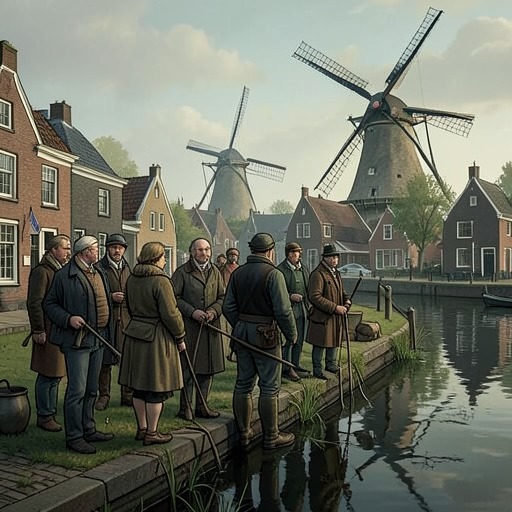
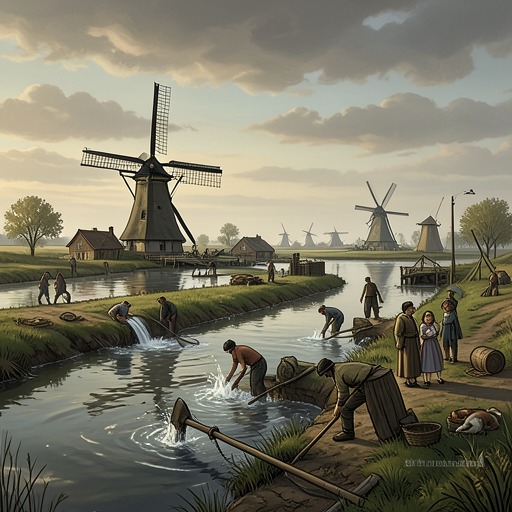
The accident took place within a system of constant maintenance. Holland’s lowlands depended on dikes, sluices, canals, and pumps to control water that could otherwise overwhelm inhabited land. The book describes thousands of windmills, many used to pump water from the lowlands into canals, as well as the continuing expense of repairing dikes and regulating water levels. These were not distant public works: people had to labor at vulnerable points when danger threatened.
The danger could come from more than one direction. In spring, thawing rivers blocked by ice might rise faster than they could drain, while the sea pressed against the dikes. At Halfweg, where the IJ and Haarlemmermeer meet, the river is described as five feet higher than the surrounding land, making strong dikes and sluice gates essential. That particular account does not place Raff’s fall there; it shows the precarious landscape in which the work at Veermyk Sluice formed part of a broader effort to keep water from the country.
The Fall at Veermyk Sluice
Raff had worked on the dikes for years. When an inundation threatened, he and the other men were laboring at a weak point near Veermyk Sluice in darkness, sleet, and a terrible storm. In that exposed, urgent work, Raff fell from the scaffolding and became insensible. The account presents no avoidable error or personal failing as the cause: the accident occurs amid dangerous conditions and the effort to reinforce a vulnerable dike.
Dame Brinker later recalled the moments immediately before and after the fall. On the night of the emergency, Raff came home for supper and handed her a watch, asking her to keep it until he asked for it again. Before he could explain further, a messenger arrived with news that the dike was in danger. Raff seized his tools and rushed out. He was brought back near midnight, almost dead, with his head badly bruised and cut. The watch thus remained with Dame Brinker as a tangible link to the last evening she saw her husband in his right mind, although its earlier history remained unknown to the family.
Survival Without Recovery
The fever eventually passed, but the dullness did not; it grew worse day by day. From the accident onward, Raff never worked again. He remained alive and physically strong, yet his mind and memory were gone. His survival therefore brought no simple return to ordinary family life: he needed constant care, and Dame Brinker sometimes struggled to control him.
The accident’s effects differ in the memories of his children. Gretel could remember only a strange, silent father whose vacant eyes followed her. Hans, who had been older before the fall, remembered a cheerful-voiced man who carried him on his shoulders; even later, Hans felt that his father’s careless song still echoed when he lay awake. The same injury that erased Raff’s former self from his own awareness left sharply unequal inheritances in his children: Gretel knew the silence, while Hans could still measure it against the affection that had preceded it.
Family Consequences and Narrative Significance
Raff’s fall helps explain the hardship and altered responsibilities of the Brinker household. Dame Brinker supported the family through vegetable growing, spinning, and knitting, while Hans took on difficult work that his mother had once done. Her care for Raff added to that burden. The accident is therefore more than an isolated workplace disaster: it redirects labor within the family and makes the father’s continued presence inseparable from his dependence.
The watch episode also ties the accident to a recurring family choice. In times of severe need, Dame Brinker sometimes took the watch from its hiding place and considered selling it, but she resisted because Raff had entrusted it to her. Her decision preserves an object from the night when the family lost the man they remembered, while the fall itself remains the dividing line between Raff’s earlier life as a worker and father and the long period of incapacity that followed.